
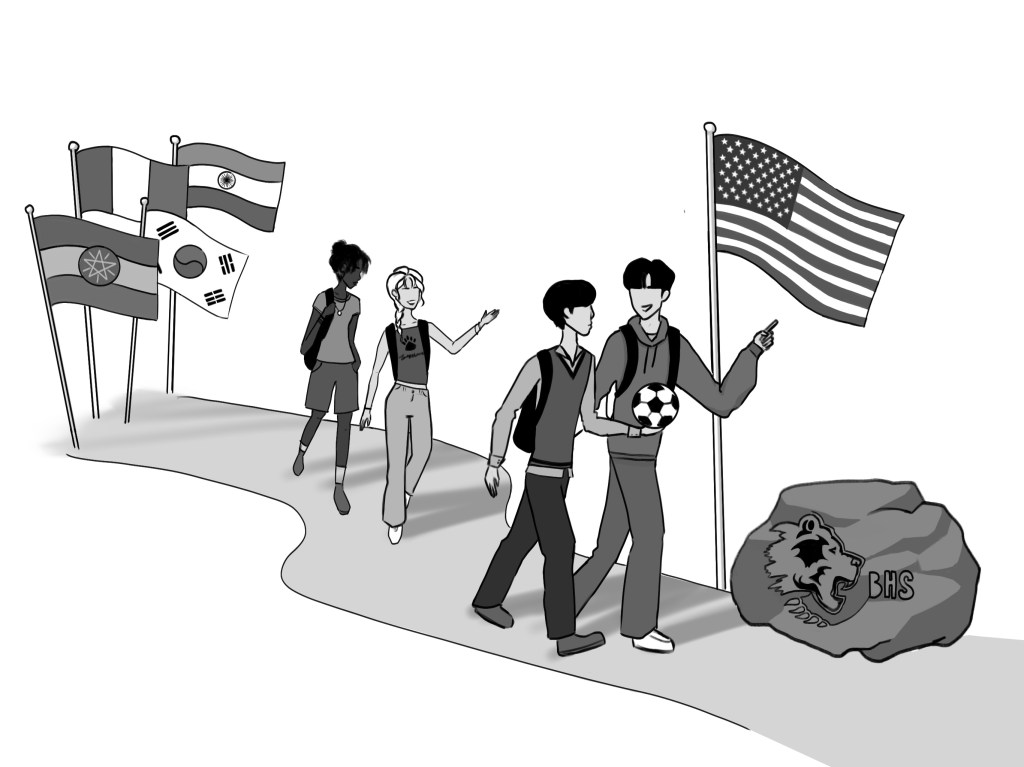
Branham is a diverse campus with people of many ethnicities and cultures, including students who have transferred from schools abroad. Many of these students have gone through the motions of learning a new language and adapting to a different culture while keeping up with the typical curriculum. With 264 students born outside of the U.S. attending Branham, this topic is ever-present in the community.
Transitioning to high school in the United States can be difficult for some due to the culture shock and the need to learn English. However, students like senior Daniel Lee have found ways to adjust to a new environment through actively participating in Branham activities. Lee moved from Korea to America in August of 2022, and has continued with his love of soccer by joining the school team.
“What helped the most was joining a school sports team,” Lee said. “I play soccer, so playing sports with the other boys helped me improve my English and build my friendships.”
But while the transition may be difficult due to language barriers and cultural differences, some students find an academic environment in America easier to adapt to compared to their home countries.
Lee highlighted the competitive culture of high schools in Korea due to the nature and pressures of their relative grading system that allows only a certain number of students to earn each grade. This means their grade is based on academic ranking.
“In Korea, even if you did good, if the person next to you does better, then you get a B instead of an A,” Lee said. “It’s just like competing constantly.”
The culture at Branham is different from some schools outside of the country, especially where diversity is scarce. According to the American University School of Education, diversity is crucial for fostering creativity and different perspectives in the school setting because it allows people from different backgrounds to collaborate.
“In Korea, there’s only one race,” Lee said. “[But in] America, you really have a variety of races or ethnicities, so there’s different culture and languages and I really enjoy that.”
Senior Dan Dagne, who moved from Ethiopia to America in Sept. of 2024, noted the variety of options at Branham, as someone on the basketball team. Branham not only offers academic opportunities, but a wide variety of extracurricular possibilities like sports, clubs and community options. This contrasts Dagne’s old school in Ethiopia, which was focused more solely on academics.
“Back in Ethiopia, they didn’t support sports,” Dagne said. “I have a lot of opportunities to do what I want [at Branham].”
Similar to Lee, Dagne noticed the major contrasts in diversity from Branham to his school in Ethiopia. In addition to the diverse population, Branham is also different due to its large population.
“Branham is way bigger than the school I went to,” Dagne said. “And it’s more diverse and has a lot of people from different backgrounds.”
Dagne also noted that academics in America seem to be less challenging than in Ethiopia due to the more exam intensive curriculum there.
“Ethiopia is harder because it’s different curriculums,” Dagne said. “It’s not like here with classworks and homeworks, but there it’s assignments, working and [more] exams.”
Teachers are another instrumental factor in a student’s ability to transition with ease. Korean language teacher Sunyoung Jeon supports her students, including those who have moved from abroad.
“I myself as an immigrant can empathize with their experience,” Jeon said. “So I share my experience, I give them tips I have for adjusting to the new setting.”
Not only are transfer students welcomed at Branham due to the diverse populations and cultural identities, but they can also find comfort in their various classes, especially world language classes.
“In these courses [of world languages], we are ready to embrace the linguistic and cultural differences,” Jeon said. “They don’t need to be intimidated about their differences. They can be confident to share their own diversity in this class setting.”
Overall, the transition to an American school can be easy or difficult, but the support from admin, teachers and students alike can make a big difference.
“As soon as I moved here, the principal talked to me, and then she introduced me to one of my classmates,” Dagne said. “And he just gave me a tour around the school and he introduced me to other people.”
Peers can be a helpful resource for assistance, especially during class.
“People in America are really kind and positive,” Lee said. “Whenever I ask them questions, they answer them politely. Whenever I have something that I don’t know, they teach me. That really helped overall.”
Lee recommends to all people moving here from abroad to reach out to others for an easier time adjusting.
“[Reach out] to people,” Lee said. “People want to help you, so just go up to people and ask them questions and be positive.”
Illustration by Irene Yoon

 Branham Bear Witness
Leave a comment