
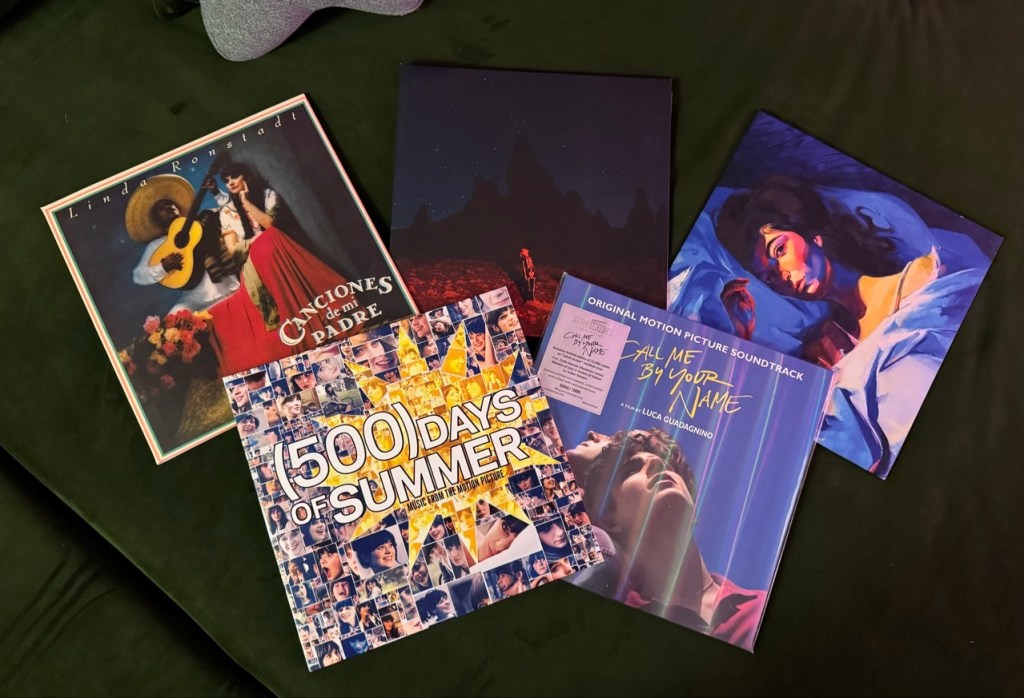
In the age of streaming platforms like Spotify or Apple Music, the Branham community has seen some students and teachers turning back to physical forms of media.
In recent years, the music industry has seen a resurgence in analog methods of listening to music. These physical medias refer to the tangible objects that contain sound, such as a CD, cassette tape or vinyl record. Most popularly, a vinyl record is a thin, circular piece of PVC pressed with a spiral groove that contains playable music if used on a turntable. According to Luminate data, vinyl records have become the driving force for the physical media push, seeing a 300% increase in sales since 2016.
For music enthusiasts, owning a physical album is more than just a means of listening to music. Band Director Christopher Nalls believes that there is an important difference between streaming and vinyl.
“There is a real visceral feeling of accomplishment when you’re actually handling the albums,” Nalls said. “Vinyl is the best audio reproduction that’s been created.”
In comparison to physical music, an exact replication of a recording, Nalls believes the rise of streaming has drawbacks. The loss of audio quality, for example, which reproduces sound from a series of numbers first, then converts it back to analog to be played digitally through a streaming service.
“The transition to digital away from analog has resulted in lower quality,” Nalls said. “Everybody is used to listening to audio on the low quality, little speakers in a cell phone that is so far from fidelity. It’s just unimaginable.”
Social Science teacher and record enthusiast Stefanie Menera has also noticed a difference in sound quality between streaming and physical media. She believes that streaming services fail to do musicians’ work justice.
“I don’t think that being able to just stream something over cellular data with Bluetooth is going to deliver the same exact quality that a producer or an artist might have intended,” Menera said. “Especially with some of the older albums—things that would have been originally released on vinyl.”
Nalls believes that the difference between digital and analog is vast.
“If you’ve ever seen ‘The Wizard of Oz,’ it starts off in black and white, and then when [Dorothy] gets to Oz, she opens the door, and it’s this beautiful world of color,” Nalls said. “That’s what it’s like when you listen on decent gear to a good recording.”
Even though she has a fondness for vinyl, Menera recognizes why streaming has become the main form of listening to music. It takes significantly more effort to place a record on a turntable than it does to press play on a phone.
“We’re all on the go and there is an element of convenience,” Menera said. “Sometimes, you have to throw in AirPods and call it a day.”
Junior Ismene Potens has collected vinyl since 2020. She believes that the ease of using streaming changes the way people engage with music.
“With streaming, you can just pick what song you want to listen to,” Potens said. “When you actually buy it on vinyl, you can’t skip a record of every single song.”
Potens feels streaming does not compares to owning physical media.
“Buying albums physically is a whole experience,” Potens said. “Some records come with picture books or posters so being able to hold the album creates a special connection and I feel like a true fan.”
Not only has streaming shifted the way people engage with music, it has also impacted the amount of money artists make for their work. Nalls criticizes the streaming shift, commenting on the lengths artists must go to in order to make a living. According to One Submit, artists get paid about $0.003 to $0.004 per stream on apps like Spotify.
“If you’re going to make any money as an artist, you have to tour, you have to sell merch, and that favors a successful artist,” Nalls said. “If I’m consuming digital audio, I’ll buy it on Apple Music, because I know that the artist gets more from it.”
While vinyl can be expensive, Menera values this aspect of buying physical media, recognizing it changes the cultural phenomenon of overconsuming music catalyzed by streaming services.
“What is special about collecting vinyl is it forces you to slow down and it forces you to really listen to an entire album,” Menera said. “There’s something really special about being able to slow down and especially step away from technology.”
Menera also believes physical media creates something streaming fails to replicate. It allows someone to take ownership.
“Sometimes there are albums and songs that you love so much that listening isn’t enough,” Menera said. “You want to literally hold it in your arms, and that’s the experience that vinyl gives. It’s art.”
 Branham Bear Witness
Leave a comment