
Ever since visiting Yosemite National Park in middle school, Jane Doe knew she wanted to work outdoors and take care of the environment. Doe, a Branham alumnus speaking on the condition of anonymity, chased her dream and found a position at the Department of the Interior — which preserves America’s natural resources and cultural heritage — after graduating from college.
But now, she’s uncertain if she will keep her job. Being unable to log in to her computer could be the only notification she receives.
Across the federal government, tens of thousands of employees were laid off en masse or offered voluntary separation packages as the Trump administration and the Department of Government Efficiency, created by an executive order, seek to reduce the size of the government.
The New York Times estimates that over 131,000 federal employees have been dismissed. About 56,230 employees were cut while around 75,000 took buyout offers as of April 8. Courts have ordered temporary reinstatements of many workers, but the government plans to lay off at least 146,000 more workers, according to The Times.
Probationary employees — those in their first or second year on the job, or those who were recently promoted — were targeted, likely because they lack appeal rights and can be terminated quickly as long as their superiors provide a performance-related reason for firing them.
Even though nonprobationary employees have more appeal rights, many have been removed from their positions through reductions in force.
It’s a worrying situation to Doe, who fits the bill of a probationary employee that can be let go on a moment’s notice.
“I don’t think I’ve had a good night of sleep since Inauguration Day,” Doe said, adding that she doesn’t have any family or community in the area because she just moved. “I might be losing my source of income and my job that I’ve wanted to do since I was in high school. I worked hard. And the fact that it could just be swept out from underneath me at any time is scary.”
Doe knows people who have gone to work only to be fired by 10 a.m. with just an email notification.
“Every time I hear the Outlook sounds that come through my computer, I jump, because it could be that, ‘Oh, by the way, you’re no longer employed in the federal government’ [email],” Doe said.
The looming possibility of losing her job has forced Doe to prepare job applications, save money and consider moving back home.
As a probationary employee who makes about $40,000 a year, Doe said the idea that the average federal employee makes $100,000 annually is a misconception.
She has turned down multiple offers to leave the government, refusing to quit her job voluntarily.
“I’m not leaving until they make me,” Doe said. “But I plan on staying on. What I do is important, no matter what anyone else says. Our public lands are worth defending, and I commit to defend them until they say I can’t anymore.”
According to Doe, while the government has offered little information or reassurances and even censored what can be posted on the department’s official social media, members of the public have expressed positivity and support when they interact with her.
“About four or five times a week, I get a ‘Thank you for being here. We’re so sorry for what is happening. Thank you because you need to tell these stories. Thank you for not backing down,” Doe said. “To me, that means a lot more to me than some bureaucrat or high ranking official telling me that I’m not worthy of the government’s funds.”
Considering the randomness of the firings, Doe doesn’t value the government’s opinion of her.
In her department, two people — who were in the same exact position as her and who were hired the same way — lost their jobs while she didn’t.
Jane Doe’s sister, Betsy Doe, who will also be kept anonymous, commented that the American public needs to understand the randomness of the dismissals.
“[The government has] been saying a lot that it’s performance issues, and that’s who they’re firing,” Betsy said. “But that’s not the truth. It seems very randomized, and people need to realize that, push back a little more against it and not just be complacent in the whole situation.”
Betsy, a current Branham student, said that the situation was frustrating and sad, especially since she’s witnessed her sister’s perseverance and dedication to her dream throughout high school and college.
“I’ve seen how hard she worked to be able to get to this point,” Betsy said. “For her to [potentially] lose her job for no reason when she hasn’t done anything wrong, it’s just not right.”
Others within the Branham community are also feeling the effects of the firings and budget cuts.
Anonymous student Regina Roe’s mother worked at a nonprofit that helped challenged individuals get jobs and finish their education. In 2023, the company received 80% of its funding from the federal and state government.
After sweeping budget cuts, the program was eliminated in February, and hundreds of employees were laid off, including Roe’s mother.
Though Roe said her family was not severely impacted, the people served by San Jose Conservation Corps lost access to resources and grants.
“A lot of people got grants in order to support their family and support themselves through colleges, so that just all goes away,” Roe said. “Part of her program’s job was to give money to people who needed it to get through college, so taking that money away takes [away] their opportunities to go to college.”
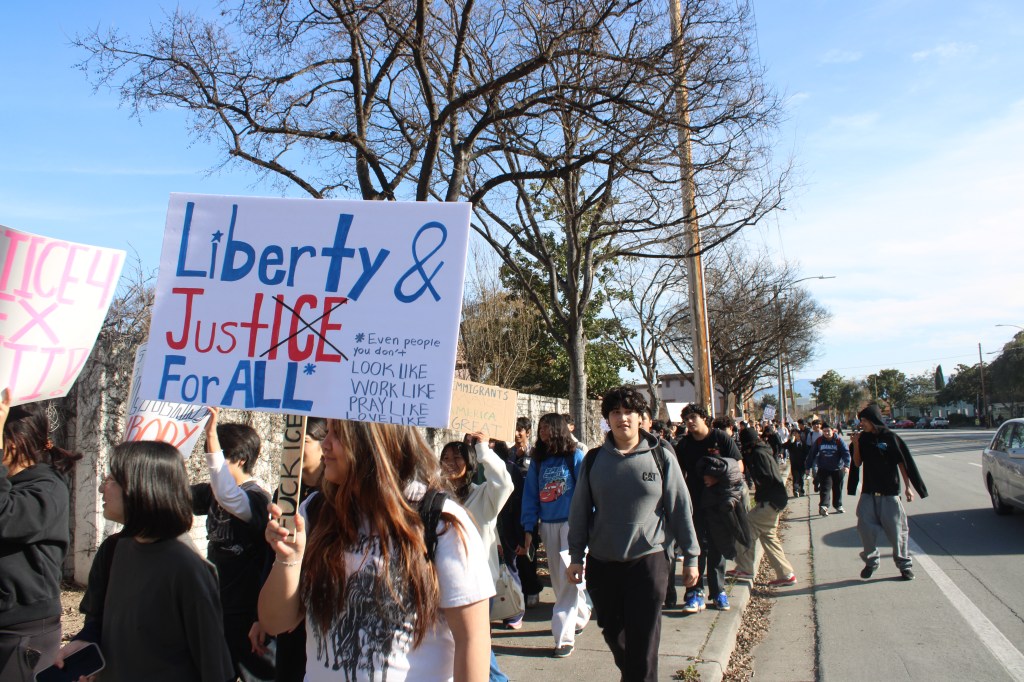
With more layoffs and budget cuts on the horizon, more Americans will be affected. Many are protesting against these reductions on the streets and in the courts, with unions and federal workers bringing numerous lawsuits and advocacy groups coordinating nationwide protests, and federal judges have repeatedly ordered the government to immediately reinstate employees.
“In D.C., I see so many people out in front of the buildings and they’re pushing back,” Doe said. “Don’t let this go away. Keep paying attention to it. They can take a lot from us, but they can’t take our unity.”





 Branham Bear Witness
Leave a comment