
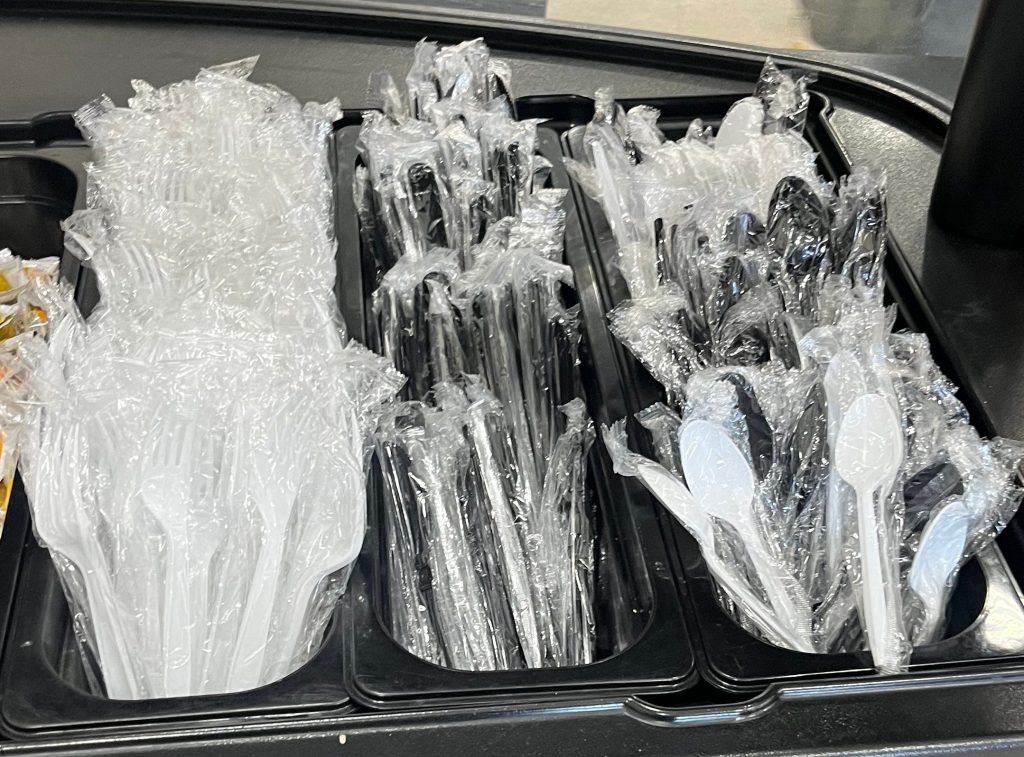
Single-use plastics are commonly used in school cafeterias to seal food and utensils.
However, most of these plastics are only used once before being discarded, generating significant amounts of waste.
Plant manager Venero Ramos estimates that trash from the cafeteria makes up about 75% of Branham’s total trash — around 90 to 100 bags of trash are thrown away every day. There are also approximately 100 blue trash cans around campus, emptied at least once a day.
Senior James Ford, who eats school food twice a day, noted that while some foods like pizza come with minimal packaging, other foods like sandwiches or salads come in plastic containers, which contributes to more waste.
“Usually, [trash] is just tucked away behind trees or just around the trash can because people miss and don’t actually put it in,” Ford said.
Although Ford acknowledged that these plastic containers keep food fresh, he doesn’t like seeing so much litter on campus.
“It makes me really sad because I care about our planet so much,” Ford said. “It’s sad to see that people are just trashing our planet.”
Ford questions if using plastic is necessary, especially because of the environmental cost and trash.
“If it’s necessary, it’s necessary, but it leads to a lot of waste around campuses in general,” Ford said. “I don’t think [using plastic] is the best way.”
He is in favor of using alternative materials for food packaging and utensils, with the exception of paper straws.
“If they found a way to make it sustainable and still preserve the food, it would be a great way to preserve our food and maintain sustainability without affecting the quality,” Ford said.
Although using plastic is convenient and easy for schools to enclose food and utensils, it leads to a lot of waste around campus.
Junior Alijah Murillo also sees a lot of trash around campus. He expressed similar concerns about the food packaging at the lunch carts.
“I’m not really a big fan of using plastic to conceal food products,” Murillo said
Ramos also voiced his concerns about students caring about waste on campus. Although the district has proposed a new recycling system, Ramos does not have high hopes for it since previous efforts to improve recycling have not worked.
“It hasn’t gotten better, it hasn’t gotten worse,” Ramos said. “Even though we try to [recycle], it always ends up about the same.”
The district currently uses double black cans, which have receptacles for both trash and recycling. It has proposed a new system of separate, color-coordinated trash cans for recyclables, compost and trash.
“They’re going to try to do the color coordinating things, which might be a little bit better,” Ramos said. “But I just don’t see anybody making an extra step.”
 Branham Bear Witness
Leave a comment