
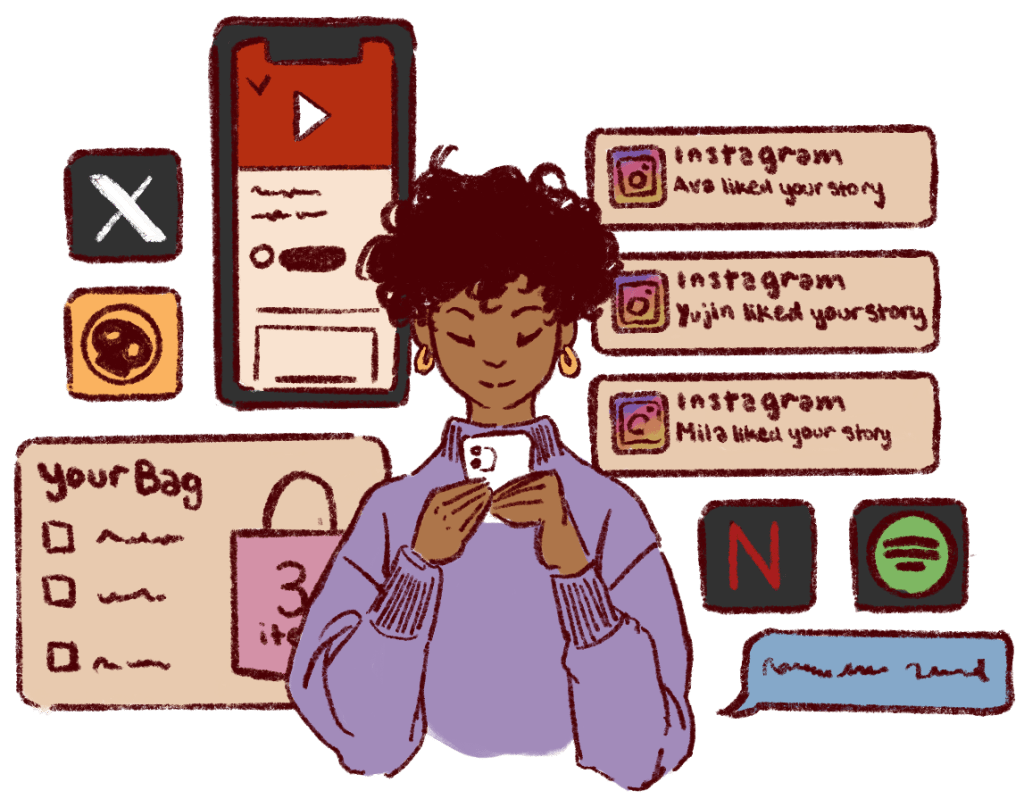
Illustration by David Tran/Bear Witness
Originally published in print in December 2024. View print issues here.
Large amounts of screen time are a constant for students and teachers at Branham with most academic activities being completely digitized.
A study conducted by the Center for Disease Control and Prevention last year found that over 50% of teens spend more than four hours a day on their phones. While online resources and platforms can help them academically, they can also cause health problems. According to a study published in the PLOS One Journal, teens can also develop mental and physical health issues because of excessive screen time.
Sophomore Elina Park spends a lot of time online, for both personal activities — such as gaming and social media — and school.
“It’s a lot of screen time, but it’s unavoidable as well because a lot of work nowadays has moved online,” Park said, citing AP tests’ shift to digital formats.
Dr. Mary Ann Shui, optometrist and professor at the UC Berkeley School of Optometry, agrees that students spend a lot more time online now than they did when paper assignments were prevalent in schools. Much of the homework assigned in school has become digital, meaning that it’s a necessity for students to be online.
“I grew up in a time where we didn’t really have computers. Computers were something that was only at the school or at a business office,” Shui said. “When we finished our schoolwork, we generally wanted to go outside, more [than kids do now].”
The increased amount of screen time that students face can hurt, rather than help, students’ academic performances, said English teacher Heather Amanatullah.
“[Phones are] definitely negatively impacting their attention spans and their ability to work through problems on their own because they have quick access to easy answers,” Amanatullah said. “I have definitely seen an impact on their intellectual curiosity and their ability to be resilient academically.”
Shui especially stresses the severity of the damage that an excess of screen time can wreak on a person’s eyes.
“If a child is constantly looking at something really up close while the eyes are developing, they’re going to [become] more nearsighted. The eyes will grow longer than they need to be, and then the person ends up with higher nearsightedness,” Shui said. “We’re seeing patients starting to wear glasses earlier and earlier. Before, they used to [get glasses] in junior high or later, but now we’re seeing kids in early elementary school getting nearsighted.”
Shui has also noticed her patients developing eye strain, a condition associated with screen time. When the human eye focuses on a particular object or spot, it doesn’t blink as much, causing the surface of the eye to dry up more. She said that people can experience irritation to their cornea, as well as general eye fatigue, if they are staring at the computer for too long.
Amanatullah, who has two teenage daughters, has witnessed a similar phenomenon firsthand and expresses concern about the physical and psychological effects of being on the computer too much. Like many students and teachers, Amanatullah struggles to make a decision on the appropriate amount of screen time that teens should have.
“If you take phones or technology away, you’re putting [students] in a socially awkward spot where they don’t have access to the same thing that kids their own age have,” Amanatullah said. “It’s a difficult dilemma. I let my kids have technology, and I try to be on top of reminding them to take breaks.”
Along with seeing this in her personal life, Amanatullah recognizes the strain it has on education through teachers and students.
“I think [technology] has ruined education,” Amanatullah said. “The pressure [students] have is always there. You can’t get away from your work. It’s always there [online]. I feel that as a teacher as well.”
Despite the obvious negatives, there are also some benefits to going digital. Park, who takes content-heavy classes including AP World History, applauds the convenience and organization that comes with digital education systems.
“We use a lot less paper when we use computers, which is good because we’re not cutting down a bunch of trees for paper,” Park said. “[Also,] sometimes having a bunch of folders and papers in your bag can build up a lot of disorganization. By having it all comprised in a Chromebook, it makes it easier for people to find certain things, or to carry things around in their bags.”
Computers and the Internet can be very useful to students, and can have definite organizational and environmental benefits when used at a healthy frequency. However, Shui hopes that patients will consider the consequences of using screens too much.
“Moderation is always the key. You don’t want to do everything on the computer,” Shui said. “The biggest harm that the devices do to teens is that they have [resulted in] students losing some of the ability to interact with each other on a face-to-face level. I think sometimes that hinders them.”


 Branham Bear Witness
Leave a comment