
Originally published in print in September 2025. View print issues here.
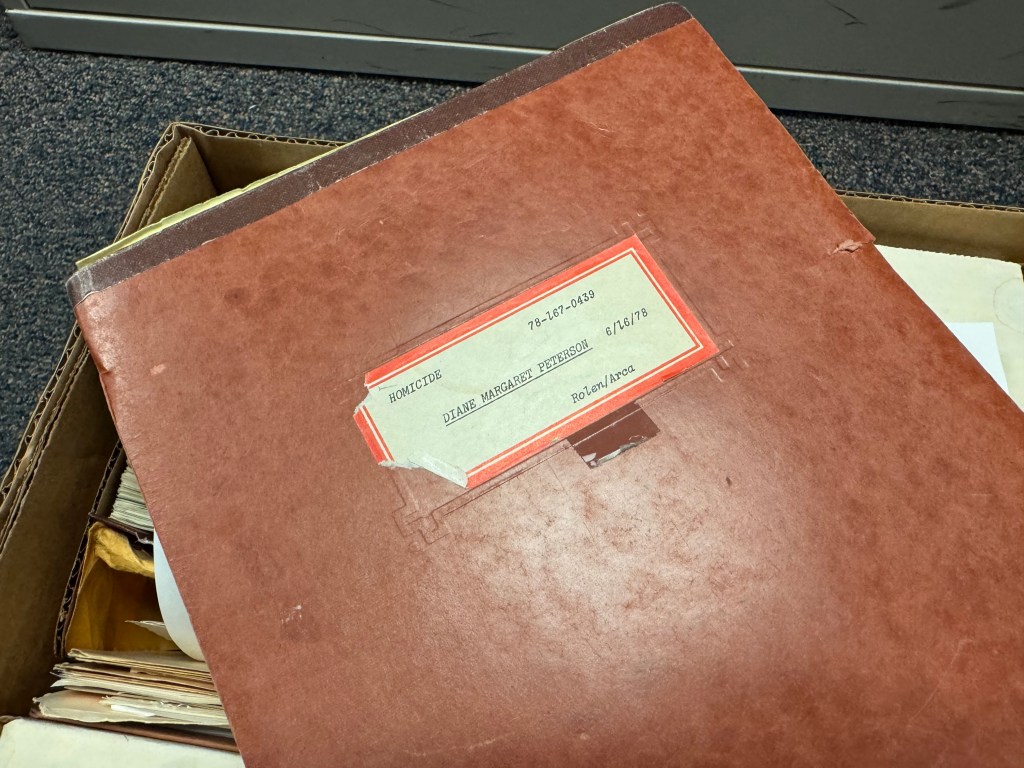
47 years and three months ago, English teacher Diane Peterson was murdered on Branham’s campus as she cleaned up her classroom, now Room 47, on June 16, 1978, the day after school ended for the summer. Peterson was stabbed once in the chest. Efforts to resuscitate her failed, and she was pronounced dead that day.
Despite police’s best efforts to track down the killer, the case remained unsolved until June 2025. The Santa Clara County District Attorney’s Office stated that Harry “Nicky” Nickerson, 16 years old at the time, was guilty of the crime.
Articles from San Jose Mercury News reveal that original investigators didn’t have many leads to follow. They did suspect Nickerson, who resembled a police sketch drawn based on witness statements, according to Deputy District Attorney Rob Baker. Four days after the homicide, police questioned Nickerson about a different crime, resulting in an unexpected twist.
“When they were interviewing him, he accused the police of trying to pin the murder of the teacher on him. Those officers had no idea there was a connection until he actually said, ‘Hey, you’re trying to pin the murder on me.’ I think that’s a pretty incriminating statement,” Baker said. “But we never had enough.”
Several witnesses did come forward with information. In 1983, the family of a Branham student informed police that the student claimed to have witnessed Nickerson kill Peterson, but the student later denied saying that. In 1984, another witness claimed Nickerson implicated himself in the killing. Even so, the police could not gather enough evidence to prove him guilty.
“The original investigators believed that Nickerson was involved in a [drug-related] group transaction on campus. Diane Peterson may have interrupted that or indicated she was going to report it, and as a result, that’s why she was killed,” Baker said.
Advances in forensic science and technology, particularly in DNA testing, couldn’t solve this cold case. Peterson was stabbed once with a weapon the police couldn’t find, and there was a lack of blood or evidence to test for DNA.
Additionally, Nickerson shot and killed himself in 1993, and San Jose police did not collect DNA back then, preventing current investigators from doing close comparisons. The crime also happened in a classroom, so even if police could have obtained a DNA profile, determining whether the DNA was from the killer or a student would be difficult.
“The problem with cold cases is we’re talking about the 1970s, 1980s and even the early 1990s. No one thought that DNA would be a thing,” Baker said. “A lot of times we have cases in which evidence wasn’t preserved because they didn’t think it would make a difference, or evidence was contaminated.”
At the time, fingerprinting was a widely used forensic tool. However, police would use the same fingerprint dust at every crime scene, contaminating it.
“If you’re dusting for prints and you’re mixing it into this container of fingerprint dust, then you get a lot of different little bits and pieces of DNA inside there,” Baker said. “Fingerprint dust is a significant contaminant to successfully identify DNA.”
After extensive DNA testing in 2023 and 2024 did not produce a definitive result, investigators led by Detective John Cary pivoted to asking Nickerson’s family for information, and they ended up talking to a relative who Nickerson confessed to minutes after the murder.
“We had no idea that the person we talked to was essentially a witness to the crime,” Baker said. “It could have been a totally different relative that we talked to, but John Cary was very good at picking the right relative and a person who not only would likely have known about it, but would have been willing to share that with us. [Cary] positioned his interview selection and his interview techniques in such a way that we were able to successfully close the case.”
Afterwards, the San Jose Police Department and the Santa Clara County District Attorney determined that there was enough evidence to prove Nickerson committed the murder and closed the case by exceptional means. Since Nickerson died, they did not file charges.
Baker said Nickerson’s relative may have refrained from telling the police about his confession out of fear of Nickerson and other relatives, adding that the passage of time likely allowed the relative to open up.
“When Detective Cary interviewed the relative, it was unquestionably an emotional moment,” Baker said. “I think that relative felt a huge weight was being lifted off their shoulders. They’ve been carrying the secret for decades, and it’s something they probably wanted to share long ago but were afraid to.”
Next: Read about Branham alumni’s memories of Diane Peterson in “Honoring Peterson.”
To view pages as printed, click the three dots on the right and select Two-page view (Chrome) or right-click and select Two pages (Safari).
 Branham Bear Witness
Leave a comment