
Originally published in print in November 2025. View print issues here.
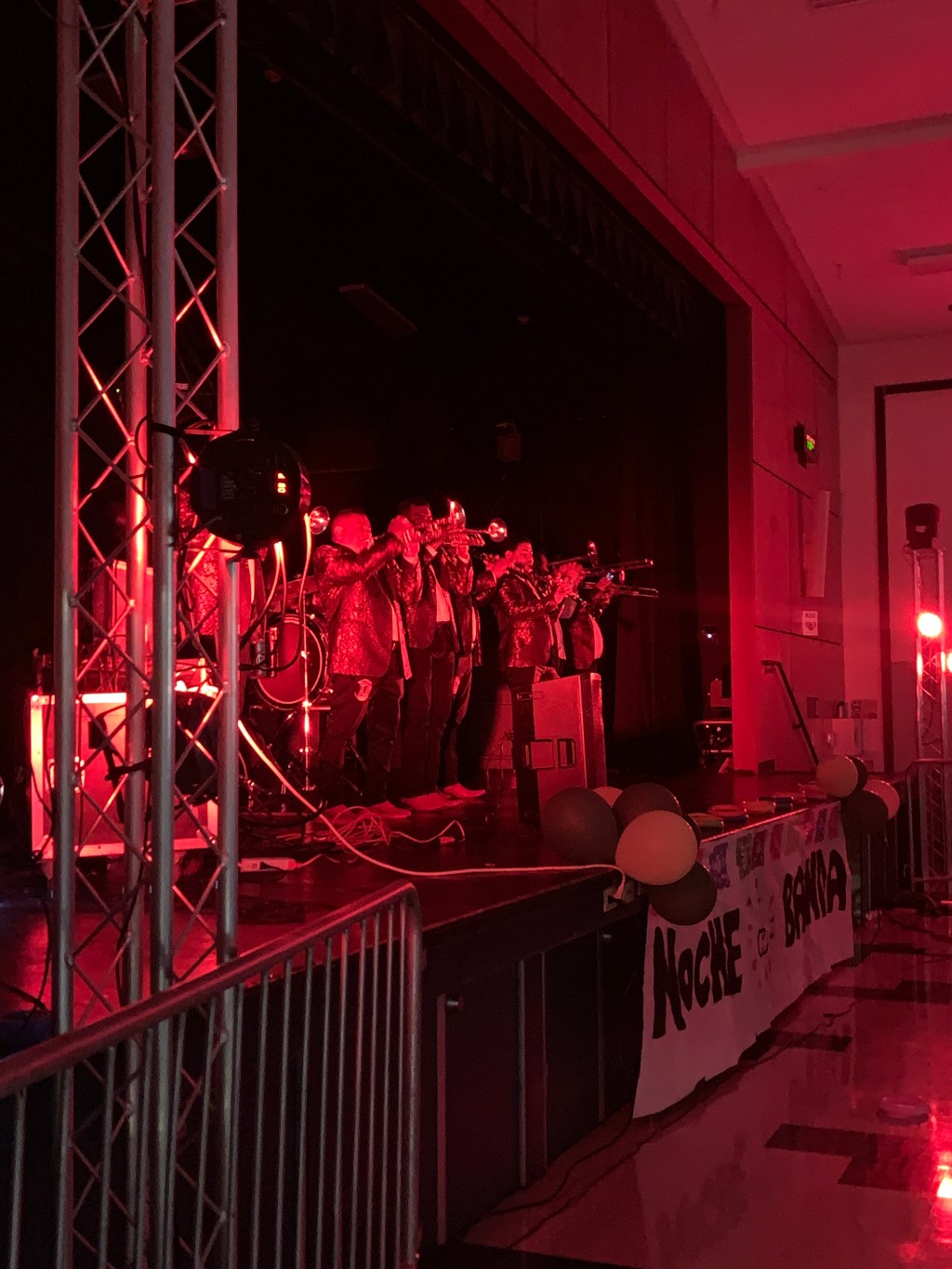
On Oct. 18, Branham celebrated Hispanic Heritage Week with its first Noche de Banda dance dedicated to Hispanic culture.
The headline event of this spirit week was the dance, Noche de Banda, which featured a performance by La Distintiva Banda, a local band. It was the first dance at Branham to play banda, a genre of regional Mexican music that features brass and percussion instruments with vocalists.
The plans for Noche de Banda started last year when ASB students pitched a dance similar to Homecoming, but specifically for students to engage with Latino culture. Activities Director and Noche de Banda’s organizer Victoria Raineri reached out to the Latinx Student Union (LSU) to collaborate. In order to commemorate Hispanic Heritage month and increase ticket sales, LSU worked with ASB members to organize and decorate for the spirit week.
LSU adviser and English teacher Olivia Tejeda appreciated how the dance attendees engaged with the music. Dancing to banda music involves rhythmic side-to-side hip movements and quick steps with a partner.
“I saw students trying to teach one another how to dance banda music, allowing themselves to look silly but putting in the effort and just having fun,” Tejeda said. “I heard students practicing the language to interact with the announcer of the band in front of all of their peers.”
Freshman Anya Desai believed the most unique element of the dance was that it involved students who don’t know much about Hispanic culture.
“It’s fun because it’s different from what we normally do, so it gives everyone a new perspective,” Desai said. “Normally people are just jumping. They have different steps.”
Raineri said that compared to other schools, the style of music played during Noche de Banda changed the way people danced with each other.
“Typically, I only see partner dancing at homecoming or prom during slow dances, so it was cool to see that type of dancing,” Raineri said.
Raineri also said that banda may be incorporated into more dances.
“I have not worked with and paid live musicians for our dances, so that was really cool and unique,” Raineri said. “Students ask for banda-style music at our dances, and it’s not always played as often.”
LSU president Mia Valencia finds that representation at Branham is important, especially during a time of political turmoil.
“We’re welcoming people into our culture, especially in a time where a lot of things are happening with immigration,” Valencia said. “[Banda is] something positive.”
Sophomore Laura Valderrama believes the dance has given the Latinx community the representation they deserve on campus.
Although Valderrama and Valencia both agreed on the importance of the Latino community being recognised, Valderrama thought the next dance could be made for a wider variety of Hispanic communities.
“The people [at Branham] come from different types of Hispanic cultures, but the one that has had the greatest impact on this dance has been Mexican culture,” Valderrama said. “I thought that I was going to see more styles of music.”
Valderrama was unfamiliar with the type of dance, since the band’s performance of traditional genres, such as rancheras, zapateados, norteñas and corridos, didn’t resonate with her part of Hispanic culture.
“At one point, I decided to ask one of [the band members] if he could play another type of music, the kind we usually dance to in Colombia and Venezuela, and he told me he didn’t know any,” Valderrama said.
Valderrama suggests some genres could be played at future dances so that more people can resonate even more with the music.
“Each region has its own style and culture, but they haven’t played salsa, carranga, merengue, vallenato or anything I normally listen to,” Valderrama said.
Desai mentioned the main struggle that Noche de Banda dance had was advertising.
“A lot of people didn’t know about it, especially because it’s the first one,” Desai said.
Raineri agreed with Desai.
“With new events, it’s always hard to educate people on what the event is [and] what they can expect,” Raineri said.
Due to concerns expressed by students, ticket prices were reduced from $20 for students and $15 with ASB to $15 for students and $10 with ASB, according to Tejeda.
Raineri encourages people to give feedback on any occasion or dance. Tejeda reassures them that they have multiple ideas to develop a more inclusive environment for future Banda dances.
“For example, fundraising for tickets, changing the day of the dance so that students can attend, making sure the dance isn’t on the same night as any other big ticket events either at Branham or in the community, maybe having a day care area for small siblings and also having the night be half-banda and half-DJ,” Tejeda said.
Community Liaison Beatriz Espinoza suggested that ASB and LSU collaborate for future events to encourage greater Hispanic events.
“They both have really great ideas, so collaborating and trying to make events or make them more schoolwide, instead of just focusing on one club, would be very helpful, and they would gain ideas and help each other out,” Espinoza said.
Tejeda has a positive look out into the future of the banda dances.
“Are there things that could have gone better? Yes. Is a goal for next year to ensure we have a bigger turn out of students at Noche de Banda? Yes,” Tejeda said. “But for the first ever Hispanic dance at Branham, I think it was a huge success.”
Photo by Danna Triana
 Branham Bear Witness
Leave a comment