
Originally published in print in February 2026. View print issues here.
Branham hosted three Holocaust Survivor Speaker Events in conjunction with the Jewish Family and Children’s Services Holocaust Center on Jan. 27, allowing students to directly engage with survivor stories on International Holocaust Remembrance Day.
Sophomores were required to attend presentations hosted by the speakers during fifth and sixth period English classes. One presentation was held after school and open to all students and family.
The event allowed students to interact with three different speakers: George Rothman, Jeannette Ringold and Herbert Barasch. Principal Beth Silbergeld said the goal was to help students connect classroom learning with real human experience.
“We hosted three survivors from the Holocaust to present their stories and give their testimonies about their experiences as children during the Holocaust,” Silbergeld said. “We focused primarily on 10th graders because there are direct ties to the curriculum in the 10th grade.”
Beyond academics, the event aimed to strengthen empathy across campus, particularly in the wake of the antisemitic hate incident that occurred in December, where eight students formed a Nazi swastika with their bodies on the Branham football field and posted it on Instagram. The incident gained attention within the community and globally as international news outlets like The Guardian and The Times of Israel covered it.
“The goal is for every student to have the experience before they graduate from Branham to hear testimony from survivors so that they understand the impact that hatred and unchecked prejudice can have on individuals and families,” Silbergeld said.
English teacher Barbara Arduini played a key role in introducing the idea for the event to Branham, drawing on her memories as a student from survivors speaking at her school. Arduini had also previously taught the book “Night,” Elie Wiesel’s autobiographical account of the Holocaust, at other schools. This year, she’s teaching the book in her English 2 class at Branham.
“I emailed the principal because we were teaching ‘Night,’ which is a Holocaust survivor story,” Arduini said. “When I was in high school, we always had survivors come to my school, and I thought it was really powerful.”
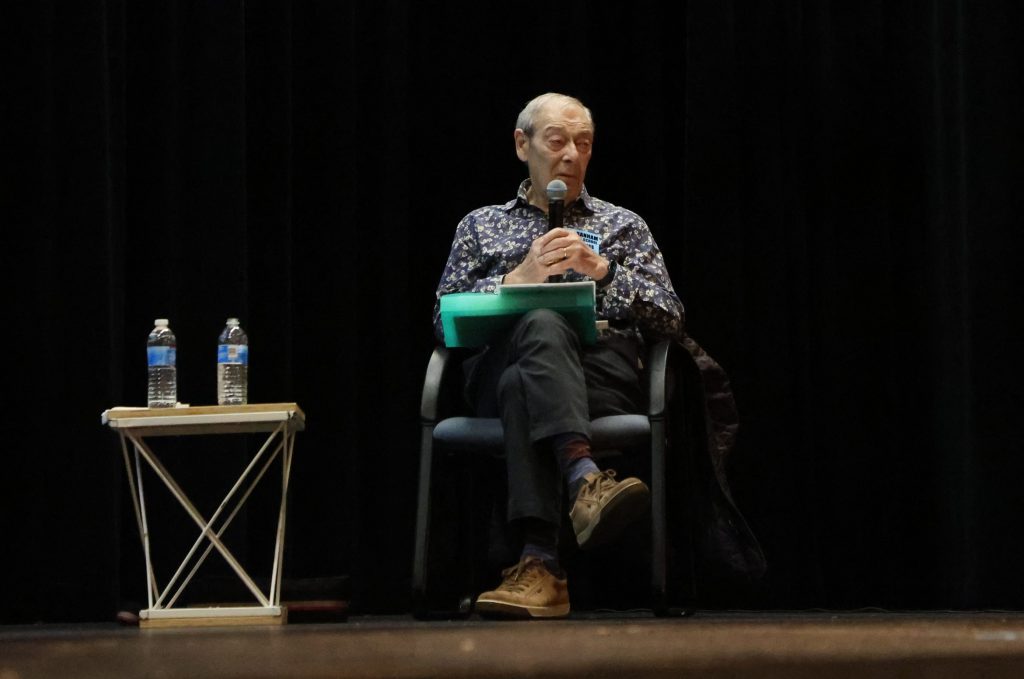
During the after school event, the audience listened as Rothman shared his story alongside his daughter, Liz Isaacs, who helped guide the presentation. Rothman began by asking students to think about their own lives and childhood.
Rothman was a child during the war in France and survived by being hospitalized when his parents were sent to Auschwitz. He was then passed between friends of his family and a Catholic orphanage before being sent to family in the United States following the war. Despite surviving, he went through a lot of devastating moments during the war.
“I’m going to begin by asking you a question, ‘Where were you on your ninth birthday?’” Rothman said during his retelling. “This is where one of the important turning points of my life took place, on my ninth birthday.”
Rothman recounted one of his last memories with his parents before they were deported.
“My parents came to visit me, and my mother started crying, and so I started crying too because whenever my mother cried, I cried,” Rothman said. “I don’t know why she was crying, but I cried because she was crying.”
Rothman also described the complex adjustments of his post-war life in the United States.
“Now, I’m 12 years old, and I have to do four things,” Rothman said. “I have to learn a new language. I had to get used to a new way of life because Paris is not the same as living here. I have been going through adolescence, so that’s not easy, and the fourth thing is [that] I had to deal with the Jewish aspect of where I was now because now, I’m in a Jewish environment.”
Rothman experienced many problems reconnecting with his Jewish identity throughout the war as he had converted to Catholicism while hiding in the orphanage during the war.
“I didn’t know anything about being Jewish,” Rothman said.
Rothman felt that his survival was not because he was braver or more deserving than others.
“Nothing spectacular [happened, but what] was spectacular is that I did it,” Rothman said. “I had a chance to live and carry on my life and just be somebody.”
He ended with a message directed at the students in the room, shifting from the past to the present.
“Each one of us is very important. It’s very stunning,” Rothman said. “But just if [even] one of you is missing, we’re not here. You’re changing this whole room because you’re not here. That’s how important we are, each of them are.”
Many students found the testimonies emotionally challenging, particularly when learning how organized and systematic the Holocaust was. Arduini said this realization often reshapes students’ understanding of this event and encourages a greater level of empathy.
“Most students know the Holocaust happened, and they know it was bad,” Arduini said. “But I don’t think they’re fully aware of how methodical it was.”
Arduini emphasized the need to complete such reflections in order to recognize the emotional effect without minimizing the horrible reality of disaster.
English 2 Honors students read the graphic novel “Maus” by Art Spiegelman, which depicts a character’s experiences during the Holocaust, while exploring thematic topics, discussing emotions and answering higher order thinking (HOT) questions. Students were able to compare and contrast between the book and the speech they attended.
“It’s appropriate to be upset when learning about something horrible,” Arduini said. “But we also need to focus on the resiliency of people who survived and the bravery of those who tried to help.”
Although students missed a period of class to attend the event, Silbergeld said the experience was comparable to a field trip and worth the instructional time. Both Silbergeld and other staff members viewed the speaker series as one step toward encouraging a more respectful and informed campus climate after the incident.
Following the event, students were encouraged to reflect on the testimonies and consider how the lessons of the Holocaust apply to current events and modern forms of discrimination.
“I would advise students to hold the story they heard near to their hearts,” Silbergeld said. “[They should] let it inform how they view events today that aim to dehumanize people, especially marginalized groups.”
Silbergeld emphasized the importance of hosting the event at this particular moment, both because the number of living Holocaust survivors continues to decline and because of the recent antisemetic incident on campus. She stated that hearing firsthand testimony enables students to better understand how hatred affects the real world.
“It is crucial that we take the time to hear direct testimony from Holocaust survivors,” Silbergeld said. “In the next 10 years, we may not have any more living survivors of the Holocaust.”
Photo by Yujin Cho/Bear Witness

 Branham Bear Witness
Leave a comment