
Originally published in print in April 2026. View print issues here.
One could describe our modern world as full of color and vibrance. Apparel company GAP lists shirts in a wide variety of colors and palettes — “Chakra Red,” “Ivory Frost” and “Balsam” — while Home Depot sells such wide-ranging paint colors as “Chalky Blue” and “Warm Mahogany.”
Quite obviously, the names for these colors extend well beyond the normal range of the rainbow color spectrum. Upon my own searching up of the term “Balsam,” a color which I had never heard of nor deemed quite necessary of existence, I found that the shade was in fact that of “a midtone, neutral, mature green with a holly undertone,” according to the words of Glidden Paints, a wholesale paint company that supplies the likes of Home Depot, Walmart and others.
A short brush through the Glidden Paints website would also expose readers to what was deemed to be the “2026 Color of the Year,” more casually known as our very own “Warm Mahogany.”
I have often debated the nature and plausibility of colors that fall outside of the typical rainbow or neutral color spectrum. It is true that such terms as “Warm Mahogany” only exist within a spectrum of other colors; “Warm Mahogany” itself is a term to describe a darker red that features notes of brown. Yet why is it that this particular shade must be deemed “Warm Mahogany,” when the level of brown and red isn’t even scientifically defined?
Reddit’s very own r/colors subreddit, home of some of the greatest modern day color philosophers, scientists and identifiers of our time, has had its own trouble with color classification in recent months. Accompanied by an image, a post by user u/Curiouslygold from last December proposed one of the most answered questions in the r/colors subreddit — “What colors are these two things?” The left side of the image features an eyeglasses case and the right side features a dog toy — both objects are extremely similar in color, being about green or blue. The great Socratesean minds of the subreddit immediately rushed in to aid the nigh hopeless poster, who had admitted the predicament had led to arguments with their wife with answers ranging from “teal” to “aqua” to “cyan.”
The most curious reply, however, was one that suggested a “test [that] will save you thousands on couples counseling” denoted as the “Is My Blue Your Blue?” test. According to the commenter, this test would help the original poster understand why they and their partner had such different color comprehension. After taking the test, I not only felt more hopeful for the future of my color-dependent relationships, I felt vindicated. According to the test, I perceive turquoise as blue!
Yet, it was not the nature of my green-blue perception that produced such delight. It was the fact that there really is no defined perception of what is truly “blue” and what is truly “green.”
The fact that we can not truly define what each “color” is, outside of its relativistic point on the color spectrum, produces a problem for the categorization of colors. What’s to say that the original poster got anything out of the classification of the objects as “aqua” or “teal,” if these colors only exist as a range of different shades?
In this way, it is plausible to say that the categorization of colors into “named” categories is problematic. In order to produce an effective definition, it would be much easier for us to refer to brownish-red, than to rely on our pragmatic application of what “Warm Mahogany” is.
This notion of perceived colorist intellectual superiority is far more pervasive in the outside world than in the semantics of salmon and maroon — we as humans have a problematic tendency to attempt to categorize things that truly need not be grouped or analyzed.
Jungian thought — the discoveries and hypothesizations of Swiss psychiatrist Carl Jung — have long afflicted society in terms of his necessity to collectivise humanity into distinct archetypes. Jung’s ideas that the “16 personalities” innately produced within human beings, otherwise known as the Myers-Briggs System, have provided the basis for which developing minds have decided to base their individual self. Harvard psychologist Ellen Langer put it best in her studies on mindfulness and the impacts of fitting oneself into a stereotype that they have already been accustomed to: “If something is presented as an accepted truth, alternative ways of thinking do not even come up for consideration… When people are depressed they tend to believe they are depressed all the time.”
We see these notions in language too and our need to be overly grammatically correct. The modern English curricula emphasizes the necessity of the proper grammar and the actuality of punctuation and form; however, is there not a case to be made for leaving syntax to greater creative expression?
The standardization of modern language inhibits the development of slang or the evolution of language. Arguments over the classification of “funner” and “funnest” still continue today, with their inclusion limited to only some dictionaries like Merriam-Webster, but if these are words still colloquially used in the English language, why must they be “dictionarized” in order to use them?
In Jungian thought and standard English, much in the same way as the color wheel, there exists both a problem of definition — how do we define a personality or word? — but also a prohibition upon creativity.
If we define a color upon what we believe it must be by its hue and shun the ones who cannot “properly” acknowledge the true distinctions of teal and mahogany, we lose a bit of nuance within our own creative structure.
Little in life is there not room for nuance, yet people continue to pursue till the ends of the Earth. It was only several years ago that the great test of the “gold-and-yellow” or “black-and-blue” dress ran its course across the internet — with innumerable people insisting that the color of a dress was a hill well worth dying upon. Later, the advent of knowledge from the original poster stating that the dress was black and blue seemed at that time to be profound, but it only deepened the color dilemma. If the picture seemed to some to be white-and-gold, why mustn’t it have been?
Very much in terms of colors but in life itself, we must learn to live by what we “think” things are, and by what we think “we” are, so as to not lose ourselves in a frenzy to get everything correct to a science. If you truly believe the dress to be white and gold, or perhaps “Porcelain” and “Cream,” so be it!
Why slave away to the smug demands of the color demagogues who insist seafoam green is one shade or the other when we can choose what that shade truly means to us?
Why slave away to the demands of Jung and his 16 Personalities when we may assert ourselves to be our own person? And why must we slave away to the demands of linguists and grammatists when Shakespeare himself rejected such demands and went on to invent his own words?
We must be weary and hold the hand of reproach in our encounters with distinctionism and classificationarians, for it is our ability to express ourselves that is at stake. Avoid Glidden’s “Warm Mahogany,” for how can we truly know what it is, and how can we know that it is not the brownish-red that we are in fact after?
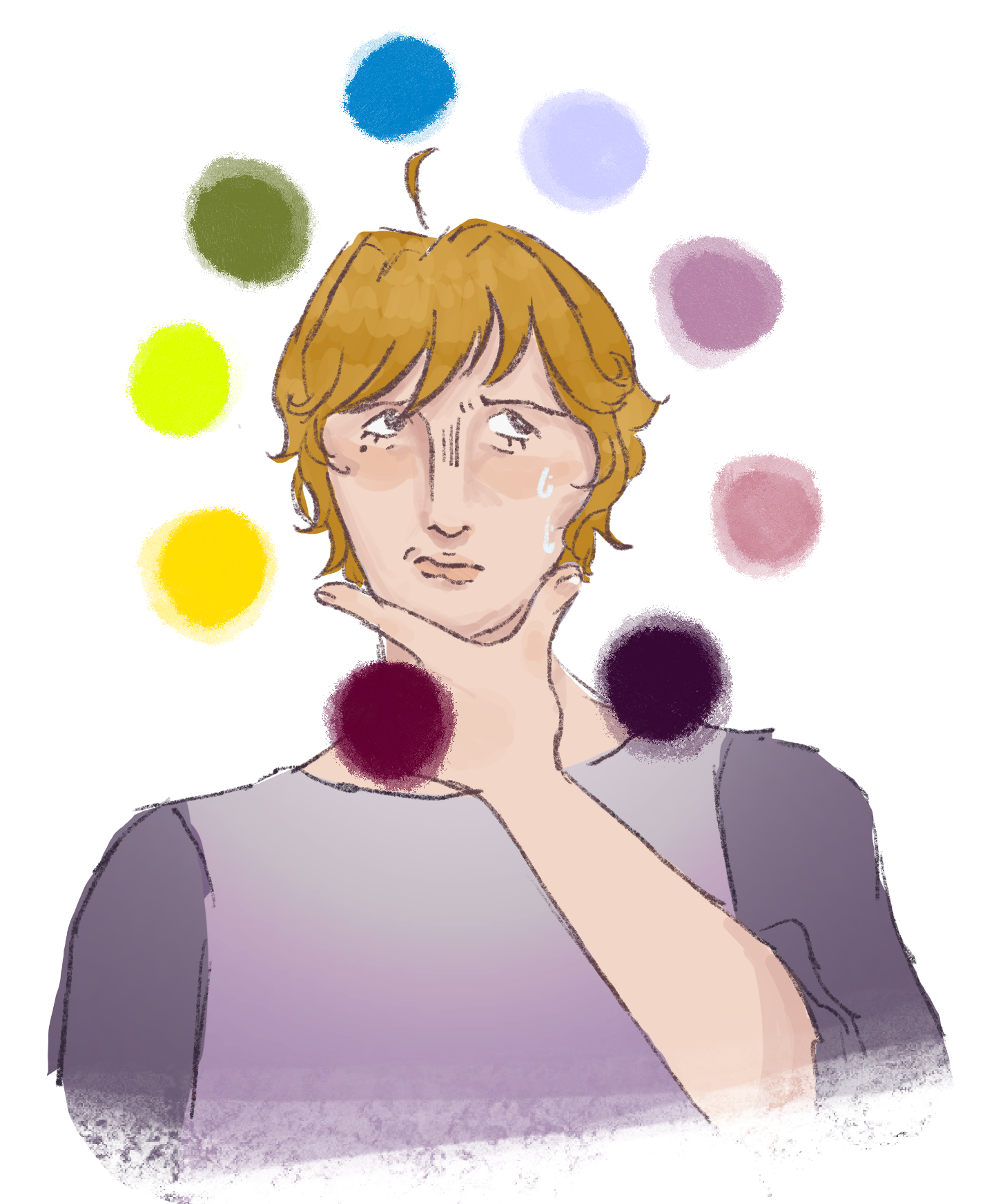
Illustration by Kailey Fu/Bear Witness


Leave a Reply