

Originally published in print in April 2026. View print issues here.
When TV enjoyers settle to watch their favorite television show or movie, they may suddenly feel the urge to scroll or use another device while watching. This isn’t just a regular occurrence — it’s called second screen syndrome.
Coined after the rise of short form content like TikTok in 2018, the term describes the simultaneous usage of another device while watching television. As audience members now tend to scroll on social media while watching a show or movie, production companies have begun to anticipate their decreased attention and thus reduce the complexity of dialogue or plot lines.
Junior Alex Solbeck recognizes this syndrome as an increasing issue, especially in young viewers in her generation. She points out that this syndrome greatly involves brain chemistry and the satisfaction scrolling creates.
“It’s instant gratification,” Solbeck said. “With all these short videos, you’re getting so much [dopamine] within a couple seconds. I absolutely do believe [this syndrome] exists, because it’s such a common phenomena within people my age. Even if you don’t know it, it’s happening to you.”
TikTok was named the most addictive social media app in a 2022 Frontiers in Psychology journal. Additionally, Addiction Center defines TikTok as an addiction due to the app’s effects on the brain’s dopamine neurotransmitter. The app provides gratification to users, offering a dopamine fulfillment similar to that of nicotine.
English teacher Bobbi Arduini shared a similar sentiment, explaining that audience members’ attention spans are directly related to television pacing.
“Movies used to be a lot slower,” Arduini said. “My own attention span has been affected, and sometimes, it’s harder for me to pay attention for a long time without wanting to check my phone, but that has a lot to do with phone addiction. There’s a lot of movies now that are probably designed to capture people’s attention in that way.”
Solbeck elaborated that phone addiction greatly impacts television production as well as viewers.
“I don’t want to say I don’t have a phone addiction because everyone has a phone addiction,” Solbeck said. “Because of social media and TikTok, our attention spans have completely plummeted. I think a lot of TV shows or movies will appeal [to] this whole syndrome. They are lessened [and have] less plot or less substance.”
Solbeck, an avid fan of the Netflix original show “Stranger Things,” has recognized the syndrome’s impact on the show’s fifth and final season. Particularly, she noticed changes in writing and creative direction taken by Matt and Ross Duffer, the show’s creators, lead writers and directors. Specifically, she noted the lack of closure as poor writing and a movement towords conformity.
“We all thought the Duffer brothers had this whole other plan and were going to tie up all loose ends,” Solbeck said. “But they ended it off not really solving anything and with a lot of plot holes, probably because they’re appealing to the general audience, as in people who don’t pay attention to the show.”
Senior Madeleine Saunders describes that the content of media isn’t the only thing being affected by the syndrome. She believes that the lack of viewer enjoyment stems from device activity rather than the television content itself.
“It decreases the enjoyment of both [screens],” Saunders said. “I tend to [scroll] when I’m a little bit less invested in the plot of the movie. I’ll just put on a movie, go on my phone and then look at it sometimes.”
Arduini describes procedural television, known for its repeated structure usually depicting professional settings, as comforting. A prominent example of Arduini’s comfort viewing is “Law and Order.” However, these shows cause her to scroll more, similar to Saunders’ perspective.
“I’m more likely to [scroll] when I’m watching a show like ‘Law and Order,’ or something that’s not quite as high-action,” Arduini said.
Humans’ attention spans are now shorter than a goldfish, averaging 8.25 seconds. According to a Microsoft study, this is just short of a goldfish’s nine-second attention span. Because of dwindling attention, it is difficult for many to engage with media, especially when the show or movie’s pacing is slower.
Saunders believes detaching from phones is the only way to solve second screen syndrome.
“It’s important to stay off your phone as much as you can,” Saunders said. “Maybe even set rules for yourself just to live your life [more].”
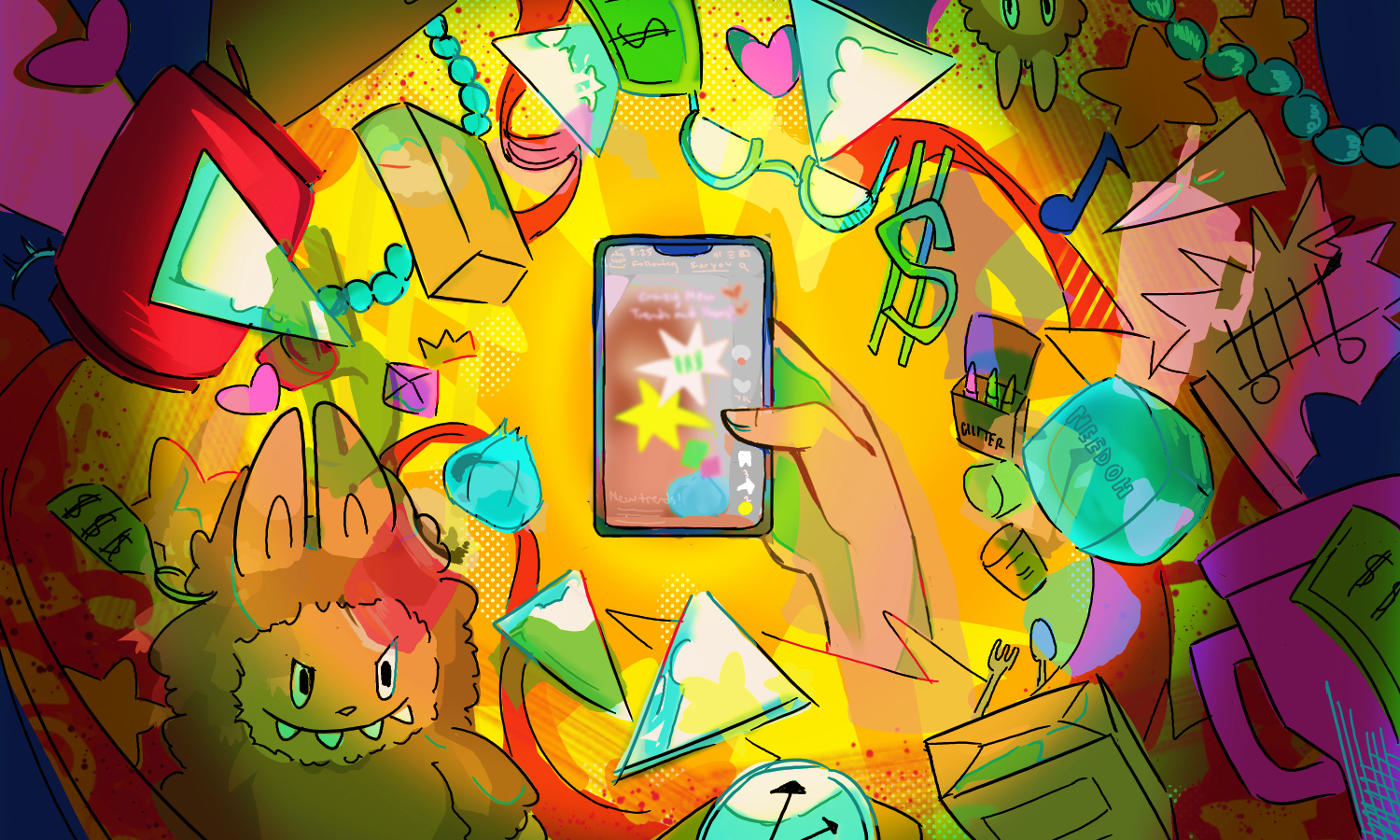
Illustration by Grace Ngo/Special to Bear Witness


Leave a Reply