
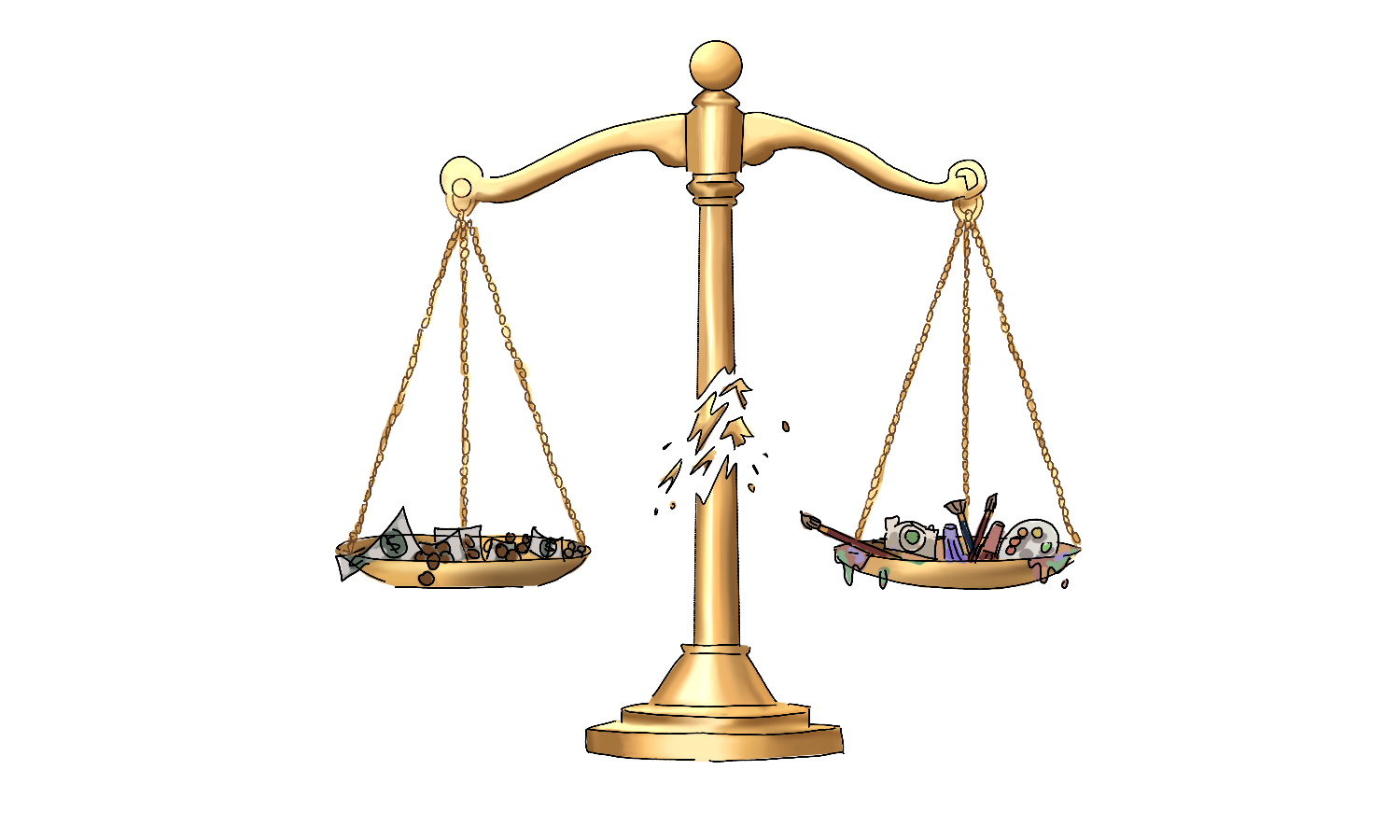
When deciding between an art path and a path that makes more money, many students struggle to decide on methods to support themselves and their interests in the future.
According to the U.S. Bureau of Labor Statistics, 3 million Americans had a fine and performing arts degree in 2023 out of an overall 63 million degree holders. When compared to the median wage, a fine and performing arts degree earns about $50,000 annually, while all other degree holders earn $70,000.
In addition, the unemployment rate for fine arts degrees is 4.9%, higher than the national average of 2.2%, according to College ROI, a website focused on financial information for college majors. Therefore, some students have questioned whether or not to pursue a market with unpredictable pay and high unemployment.
Visual arts teacher Kyilo Duran-Hulton instructs Art 1 through AP Art and holds a fine arts degree. He has seen students with strong artistic potential who also struggle with the possibility of financial burden.
“I’ve had a couple of students who were amazing. They got fives on their AP portfolio and say, ‘Oh no, I’m not gonna do art, that’s crazy.’” Hulton said. “[Instead] they’re going to be a lawyer or a doctor or an aerospace engineer.”
Hulton suggests that if students do not want to pursue art and instead focus on a more stable degree, they can still engage with art in other ways.“It’s either going to be curving what your desires are financially, or being OK grinding and working two jobs,” Hulton said. “That’s a more stable income, and also pursuing your art on the side.”
According to World Population Review, California’s average per capita income is $54,437, with household income levels demonstrating a median of $96,334. Furthermore, California has become increasingly hard to live with a fine arts degree, with the median wage being $50,000.
Junior Ace Trevethan, who wants to double major in psychology and animation in college, finds that making enough money to support oneself is limited in the fine arts fields.
“If you’re not working for Disney in general, [animation] doesn’t pay that well,” Trevethan said. “Especially if you want to start a family, it’s just not something you can pursue. You have to keep that in mind.”
Although Trevethan would like to pursue graduate education, he finds that a psychology major offers a more reliable path than an animation major.
“I’d rather put [time] towards psychology, especially if I’m already double majoring, I may as well go for something like that. It just helps you get hired for better companies,” Trevethan said.
Junior Ava Rodriguez, who draws in her free time, explains that external factors affecting the art industry also make her question her academic pathway.
“With how society has been with AI art and everything, it has deteriorated my motivation to go to an art school in the future, but I have been thinking about going still,” Rodriguez said.
Additionally, Trevethan specifies that costly art supplies might push individuals towards a more stable career.
“New drawing iPads keep going up in price,” Trevethan said. “For a good drawing iPad, it’s like $600, which might not be a lot to some people, but to people of poorer families like mine, that’s a lot of money.”
Hulton explains that many older adults in their 60s have the financial stability to return to their creative interests.
“They have a house. They have 401(k) [plans]. They have retirement [plans], and a bunch of them are now going back into pursuing art,” Hulton said. “They open up their little studios. They make art without the fear of starving, and they’re really enjoying it. I don’t know if that would work for my generation and [Gen Z].”
Hulton emphasizes that following your passions outweighs the financial burden that students face.
“Life is long, and I would recommend pursuing something that makes you happy,” Hulton said. “Because the chance of failing at it or [it] not working out is pretty much the same as pursuing something that’s going to theoretically make you money.”
Hulton elaborates that the job market is making any career unstable, so students have a better reason to pursue their passions now more than ever.
“With AI the way it’s going, and talking with a bunch of people who do work in the tech field and other places, none of those jobs sound secure at this point anymore,” Hulton said. “So, as depressing as AI is, it’s kind of leveled the playing field in terms of pursuing an art degree, which is not nearly as crazy as it once was.”
Illustration by Emi Mohanrao/Bear Witness


Leave a Reply