
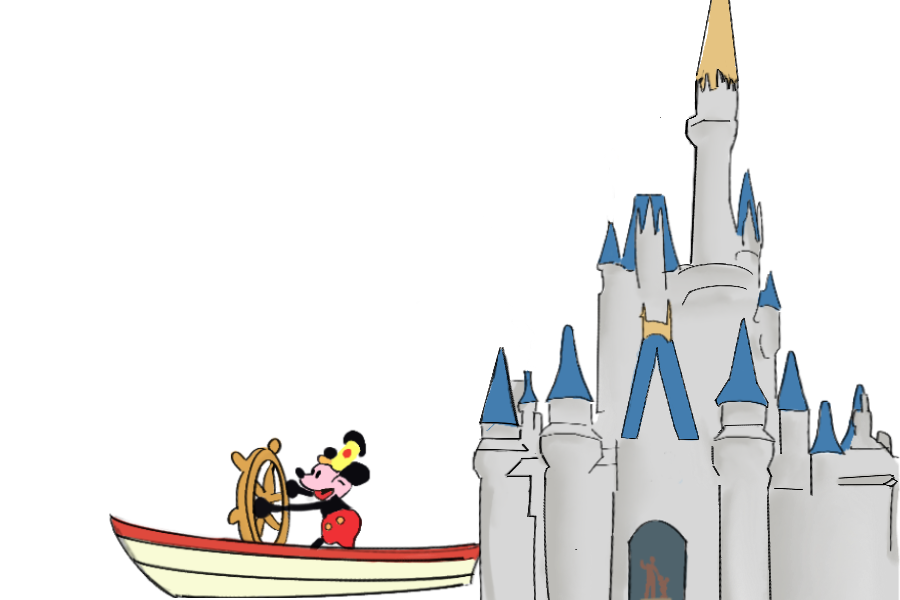
Since the creation of Mickey Mouse in May 1928, the character has become the major symbol of the Walt Disney Company. After the original version of Mickey Mouse from Disney’s Animated 1928 short “Steamboat Willie” entered the public domain in 2024, creators have now gained the ability to use the iconic character without Disney’s permission. This allows new interpretations by anybody of the company’s most famous mouse.
As of 2024, Steamboat Willie’s 95 years under copyright protection has expired.Though the company continues to protect its intellectual property, including later versions of the famous mouse, all Disney creations will eventually meet this same fate.When copyright eventually expires, a creative work enters the public domain, allowing anybody to reinterpret and use the work without obtaining permission from the original owner — with little to no limits.
SVCTE film and television instructor Jonathan Furtado believes Disney’s continuous efforts to protect its intellectual property are largely connected to the company’s financial interests.
“Profit is always their incentive,” Furtado said. “Their intellectual property is at the heart of their profit in their entertainment division.”
Despite there being public domain, this does not mean every version of a creative work is free to use. English teacher and Disney fan Kirsten McKay illustrates that the expiration of Steamboat Willie’s copyright does not eliminate Disney’s full connection to Mickey Mouse even though it is in the public domain.
“My kid is more familiar with the Mickey Mouse cartoons that came out in the 2010s,” McKay said. “He still is like, ‘This is Mickey. Mickey’s house is in Disneyland. I associate Mickey with this company.’”
Furtado stated that the public domain is not general knowledge.
“Theres specific rules of what arrives in the public domain and how long it takes,” Furtado said. “The public would probably be shocked at how long it takes for something to get put in the public domain.”
Public domain has allowed creators to experiment with these characters that have entered it. One example is the horror film “Mickey’s Mouse Trap,” directed by Jamie Bailey. The horror film uses Steamboat Willie in a far-removed version of Disney’s traditional family entertainment.
For junior Julia Quimby, a Disney fan, seeing Mickey Mouse transformed into a horror figure makes her feel uncomfortable since she connects that character to her childhood.
“You always hear [Steamboat Willie’s] little whistle, and then it comes on like an old children’s tale,” Quimby said. “I don’t want to see him killing someone.”
McKay also found the new horror figure unusual, but she believes reinterpretations of certain characters are unavoidable when it comes to creative works entering the public domain. She compares Steamboat Willie’s situation to old characters such as Dracula and Frankenstein, which recently have been the subject of new movies.
“People are just doing the horror shtick,” McKay said. “But that’s not the only type of story that can be made when people have more freedom to do things with it.”
According to the U.S. Copyright Office, copyright protection in the U.S. is limited, rather than permanent. Furtado believes this process is important for allowing future creators to develop ideas from current works.
“We need the public domain because it’s kind of the fertile soil for newer minds and imagination,” Furtado said. “It would be a sad day if people were never able to ever reference or make a derivative work.”
Despite the creativity the public domain offers, Disney has historically sought strong protection for its intellectual property. This changed the copyright term for works from the life of the author plus 50 years to the life of the author plus 70 years.
Furtado believes Disney and other major entertainment companies try to fight for stronger protections because of the continued economic value of their intellectual property.
“They will always rigorously defend their copyright and trademarks and patents,” Furtado said. “They will always do that because they’re a major corporation.”
McKay believes Disney should not receive special treatment when copyright laws are applied.
“I would be hesitant to give them extensions on their copyright,” McKay said. “I think that shutting it down would not lead to freedom of expression, which we value very deeply in this country.”
Quimby believes Disney has earned their right to protect the characters that helped establish their famous reputation.
“Disney is beautiful,” Quimby said. “I know they’re overcharging everyone, but I don’t care. They can take my money. They deserve it.”
As more creative works get older and eventually enter the public domain, Disney could face an inevitably growing number of expirations. This expiration could also lead to unofficial interpretations of their own characters being associated with different brands. McKay believes that while these interpretations may change how audiences encounter these characters, the company’s cultural influence will remain.
“I think you’ll see a lot of things in advertising,” McKay said. “Since 1928, [Disney has] been bringing you Mickey Mouse stuff, and it doesn’t stop them from still making things.”
Furtado explained how Disney still continues to excessively crackdown on copyright violations.
“They will continue to make a profit off [copyright],” Furtado said. “It doesn’t stop them from making plushies or cartoons or anything.”
McKay agrees with Furtado, as Disney is a corporation and still puts their business before consumer interest.
“They’re not always acting with their people in mind,” McKay said. “A lot of it is about ‘How can we make money off…?’”
Illustration by Pranav Ramam/Special to Bear Witness


Leave a Reply