
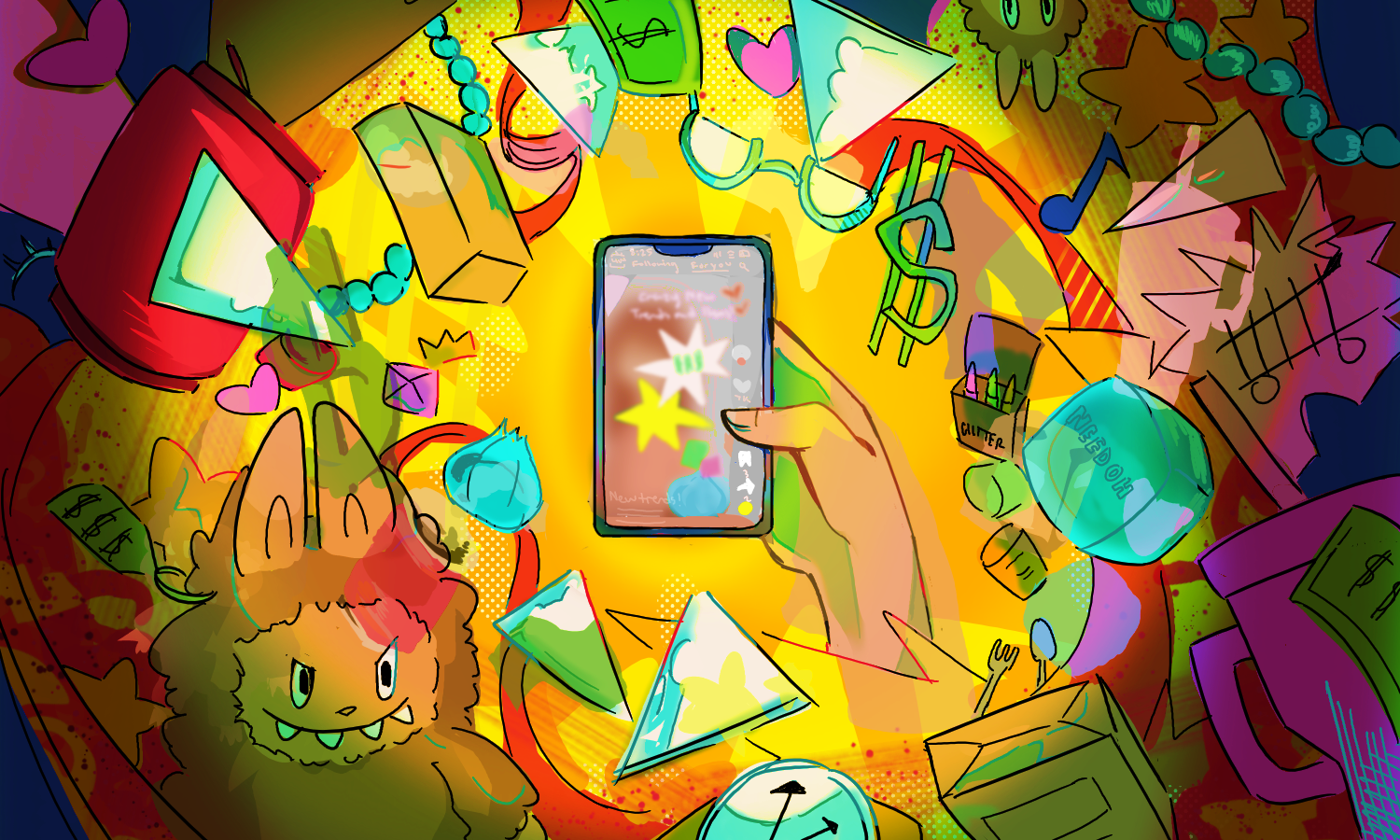
Polka dots. Nee-Dohs. Stanleys. If you have been online during the past year or two, at least one of those trends should sound familiar. One day, they are everywhere. Then before you know it, something else has taken their place.
It seems as though each time one opens social media, they are introduced to a new microtrend, beauty product or collectible that they suddenly “need” to have. But when did constantly buying something new become necessary just to keep up?
Social media has transformed consumption from something we do into a way we construct our identities, by convincing us to constantly purchase, replace and reinvent ourselves.
On TikTok, “GDWMs” (Get Dressed With Me), “OOTDs” (Outfit of the Day) and shopping hauls have become increasingly popular, flooding users with short-form videos to capture their attention. This constant stream of influencer content fuels the spread of “microtrends,” which fashion writer and TikTok influencer Mandy Lee describes as “singular pieces of clothing rather than aesthetics” that are popular one day and irrelevant the next.
Through these microtrends, we are encouraged to constantly participate, transforming what we buy into part of how we construct and communicate our identities. To participate in an aesthetic or online community often means owning the products associated with it.
A 2022 study published in Frontiers in Psychology explores the relationship between materialism and social media, explaining that materialists often prioritize “worldly attainment over spiritual attainment.” Today’s culture has created an environment where, whether we realize it or not, many people use what they buy to construct and maintain their identities, a concept researchers describe as ‘symbolic consumption.’ As humans, it is difficult to fully avoid these ideas, but absorbing this mentality can make overconsumption more difficult to escape when it manifests as compulsive buying behavior.
The study also notes how people with these traits “often [follow] herd behavior to gain social proof from their peers,” and “constantly compare themselves with influencers and their peers.” Especially with the never-ending stream of humble bragging and flaunting content we are constantly exposed to online, it can feel normal to idealize people we don’t even know with the amount of value we place on material and superficial attainments. It becomes difficult to solely blame consumers, however, when algorithms and companies benefit from making us feel like we constantly need to buy more.
Creating a problem and selling the solution is a marketing strategy which has been utilized for decades. But personalized advertising through social media has made this tactic substantially more powerful. Unlike advertisements broadcasted to the general public, social media algorithms appeal to users’ personal interests and insecurities through product recommendations, viral videos and influencer lifestyles. Especially with the rise of TikTok Shop and other online shopping platforms, purchasing products has become easier than ever. Influencers can promote items directly through their content and earn commissions from sales, making it possible for viewers to go from discovering a product to purchasing it within seconds. This convenience can encourage impulse purchases and make it easier to buy more than we actually need.
The digital world is designed to make overconsumption not only accessible, but also natural. The Frontiers in Psychology study explained how ad customization, sales, promotions and shopping environments collaboratively “increase an individual’s impulsive nature.” This consequently starts to feel less like a suggestion and more like a necessity. The study points out how “exposure to advertising messages may result in negative comparisons and in an increased need to acquire the advertised products or services.” Advertisements implicitly suggest that improving your self-image, upgrading your lifestyle or pursuing your interests requires buying the products being advertised, fueling modern overconsumerism.
With all of that aside, it may still sound fun or enticing to try finding the glitter dumpling squishy, buy a new teal and coral wardrobe because it is trending or purchase another influencer’s recommended workout supplement.
But unfortunately, acts of consumerism have major environmental and societal effects which need to be considered.
For example, a research article published on Science Direct found that in 2020, 87% of discarded textiles ended up in landfills, even though most of them can be reused or recycled. When one buys more than they need, discarded items don’t just disappear after they are thrown out, they remain in landfills and unnecessarily pollute our earth. This can be true with clothing, beauty products, squishies and any other overly-consumed product.
The Science Survey also states that less than 2% of the 60 million factory workers in the fast-fashion industry alone make a living wage, with workers additionally facing poor working conditions and exploitation. Though the unethical treatment of these laborers is not a new conversation amongst the public, most consumers aren’t aware of the extent and severity of this problem. Much of this burden remains hidden from consumers, who rarely see the conditions behind the products they purchase. The same goes for environmental impacts. But while these consequences may not directly affect the average person, that doesn’t make them unimportant.
Contrary to popular belief, fast-fashion companies aren’t the only culprits of such acts. Ultra-fast fashion, e-commerce giants and high-volume mass-production companies sacrifice ethical practices to produce products at the fastest and cheapest rate possible. A study by the University of San Diego highlighted how global corporations like SHEIN, Apple and Starbucks are guilty as well. It doesn’t matter whether they sell food or fashion, toys or tech, they could still be participating in mass deforestation, labor exploitation, excessive pollution while simultaneously using intentional marketing strategies to make consumers believe that they need to buy more of what they are selling. Is it worth further contributing to this negative feedback loop just so we can have our daily matcha? Or should we question if the quality of our lives is solely reliant on what we buy, how much we buy, and where we buy it from?
Efforts to push living a sustainable lifestyle and avoiding specific companies such as Temu and Shein are important conversations to be had, but often fail to recognize the root cause of overconsumption. Mandy Lee argues that even supposedly “sustainable” shopping habits, such as thrifting, can contribute to overconsumption.
The issue is not solely where we buy from, but how frequently and how much we buy. A new trend on social media called “deinfluencing” has gone viral, which environmental educator Isaias Hernandez described to Vogue Magazine as “[educating] the general public on the need to divest away from obtaining or upholding an excess of products that are not needed in [our] daily lives.” Although it isn’t the only solution, deinfluencing can be a tool to combat the consequences of overconsumerism and also shift our perspective on consuming itself. So while we should be conscious of whom we are buying from, we also need to question whether we actually need what we are buying. How much value is this adding to my life? Do I own anything else that serves the same purpose? Is this something I need or something I want? Are the larger consequences worth the personal benefits?
Illustration by Kate Gennari/ Special to Bear Witness



Leave a Reply