
Originally published in print in April 2026. View print issues here.
“Self-actualization.” I did not know what that meant until researching psychology for this article. However, I have realized I have been practicing it for approximately 6 months.
The American Psychological Association Dictionary says that self-actualization means “the complete realization of that of which one is capable, involving maximum development of abilities and full involvement in and appreciation for life, particularly as manifest in peak experiences.” In other words, self-actualization means reaching towards one’s fullest potential.
For much of the previous school year, I developed debilitating anxiety and social anxiety. I was busy with multiple extracurriculars and extra classes, but I often felt like I didn’t achieve anything. I went to countless social gatherings, but I often felt disconnected. I was embarrassed of my anxiety, and I thought there was little to no solution.
I did a couple of months of therapy to improve my social anxiety, which did give me efficient tools to navigate my issues. Although, it took a long while for me to actually apply them on my own.
Six months ago, I dislocated my knee cap and had a bone bruise with a sprained ACL. As a dancer and theater performer, I was devastated. However, I realized how many things in my life I had taken for granted now that I couldn’t do them. I had spent so much time worrying about the simplest things, but now I had something real to worry about.
From there, I set myself upon a journey to manage my anxiety as best as I could and feel more satisfied with my life by achieving my fullest potential despite my physical limitations.
I have worked towards my fullest potential using principles I created that were fairly similar to the four principles of self-actualization as described by Psychology Today.
First, there is “openness to experience,” meaning that people must be flexible towards the occurrences in their lives and open to diverse perspectives.
Openness to my experiences has helped me accept everything that has come my way — even if it seems difficult or unpleasant. I see every opportunity as a way to grow rather than an enormous challenge. In addition, I take in information calmly and slowly, reflecting on how I feel about it to see what progress in my perspective is needed to accept it and grow from it. I also am much more observant of my actions and others, allowing me to build my perspective on life with full awareness of my surroundings.
Second, there is “value reflection,” meaning that people must identify who they are and what their values are in order to achieve stability in their identity and grow within it.
I have reflected a lot on my values and my identity. Fully understanding who I am has strengthened my confidence and allowed me to accept the parts of myself that I didn’t like before. In addition, I’ve recognized that I needed to establish my own values rather than basing them on someone else’s. My main values include hard work, honesty, kindness and confidence. Strengthening these values helped me navigate my life more confidently by allowing me to clearly see what goals I was striving towards.
Third, there is “move beyond self-esteem needs,” meaning that people need to establish and meet their goals in life in order to achieve their fullest potential, no matter the level of self-esteem they have.
I approached everything beyond my self-esteem. I was not confident in myself, but I believed that with time, I could do what I set my mind to. My goals were to maintain emotional stability, work hard in my classes and activities and make a positive impact on those around me. These have always been my goals, but I finally gave myself permission to pursue them even if I doubted myself. As of now, I have met my goals, but I know there’s always room for improvement. Through that, my self-esteem has significantly improved, and I have the courage to be the person I want to be.
Finally, there is “live authentically,” meaning that people decide where they want to go in life so they can reach beyond what they want through self-actualization.
I have lived for myself and identified what I want in my life. I have worked towards those goals in hopes of achieving beyond the initial outcomes. When things didn’t work out, I started to brush it off instead of overthinking the reasons why. The amount of successes I have had has gone beyond what I’ve ever initially wanted, and that has also altered where I want to go in my life.
To be clear, I have not reached my fullest potential, nor have I achieved full self-actualization. After a long journey, I still have social anxiety and general anxiety. However, I have been able to manage it much better, and I feel fulfilled in life because of the work I did towards self-actualization.
As I have noticed significant improvements in myself, all of these factors add up intellectually to build a more positive mindset and identity. The longer these factors are processed, the stronger self-actualization will become. It’s important that people practice this mindset to help themselves grow like I did. Psychology supports why these shifts towards self actualization can make such an impact.
Neuroplasticity, the flexibility of the brain’s function and structure as suggested by the British Broadcasting Corporation (BBC), adapts, grows and teaches the brain new paths of thinking based on what is being put into it.
As described by Psychology Today, positive self-talk and mindfulness can open neural pathways that increase the ability for the brain to grow towards positive cerebellar regulation. Based on the internal narrative people create for their brains, their experience is changed. For instance, if the brain is fed negative self-talk, it can decrease motivation and self-esteem. However, when the brain is fed positive self-talk, it can have the opposite effect.
For example, when I was struggling, I always thought to myself, “I do all this work to be successful, but it doesn’t really mean anything.” Practicing self-actualization, I would instead affirm myself that “I am more talented than I know, and I deserve all my opportunities I take.” Even though my workload has only grown since beginning self-actualizing, my mindset has helped me enjoy and manage everything much better.
In a BBC article, “How I rewired my brain in 6 weeks,” science journalist Melissa Hogenboom practiced positive brain reinforcement in forms including meditation and mindfulness.
Hogenboom did a brain scan before and after the six weeks. The results showed changes in her brain structure.
Her amygdala, the emotional hormone regulator, decreased in size because her brain had been able to regulate her emotions much more efficiently after practicing mindfulness and positivity.
In addition, her cingulate cortex grew. The cingulate cortex controls the behavioral and emotional responses of the body. An increase in its size indicates that her mindfulness practice allowed her to hone in on her focus and respond to her environment through the cingulate cortex.
It’s especially important to pave these neural pathways during adolescents. A 2013 article by Mariam Arain et al. says the stage the brain develops the most encompasses the ages of 10 to 24.
During this period known as maturation, the body and brain experience various changes. The brain at this stage is particularly vulnerable to new changes in feelings and identity. Regulating the brain properly during maturation is essential as it impacts the way it develops into adulthood.
Self-actualizing during this period is important because it is the first stage of success that leads adolescents into their future stages of life. If they work towards this state of life, they can reach their goals as strongly as possible.
Especially during the teen years, these changes are the strongest and very difficult to go through. Self-actualizing during this period is helpful for managing those emotional physical changes instead of letting them drive one’s experiences of life.
As a growing teen, I experience extremely intense and negative emotions. Over time when practicing self-actualization, I have learned to overcome these emotions and not let them control me. Instead, I have used my logic to fight against simple situations that I once thought were a big deal.
According to Penn Medicine, it is vital to consider that there are multiple factors that create a person’s environment which can impact the brain’s ability to learn and develop. In addition, the body’s stage of life determines which part of the brain is developing the most.
I come from a middle class family with a good education and very supportive parents, which made it easier for me to work towards self-actualization than it might for others.
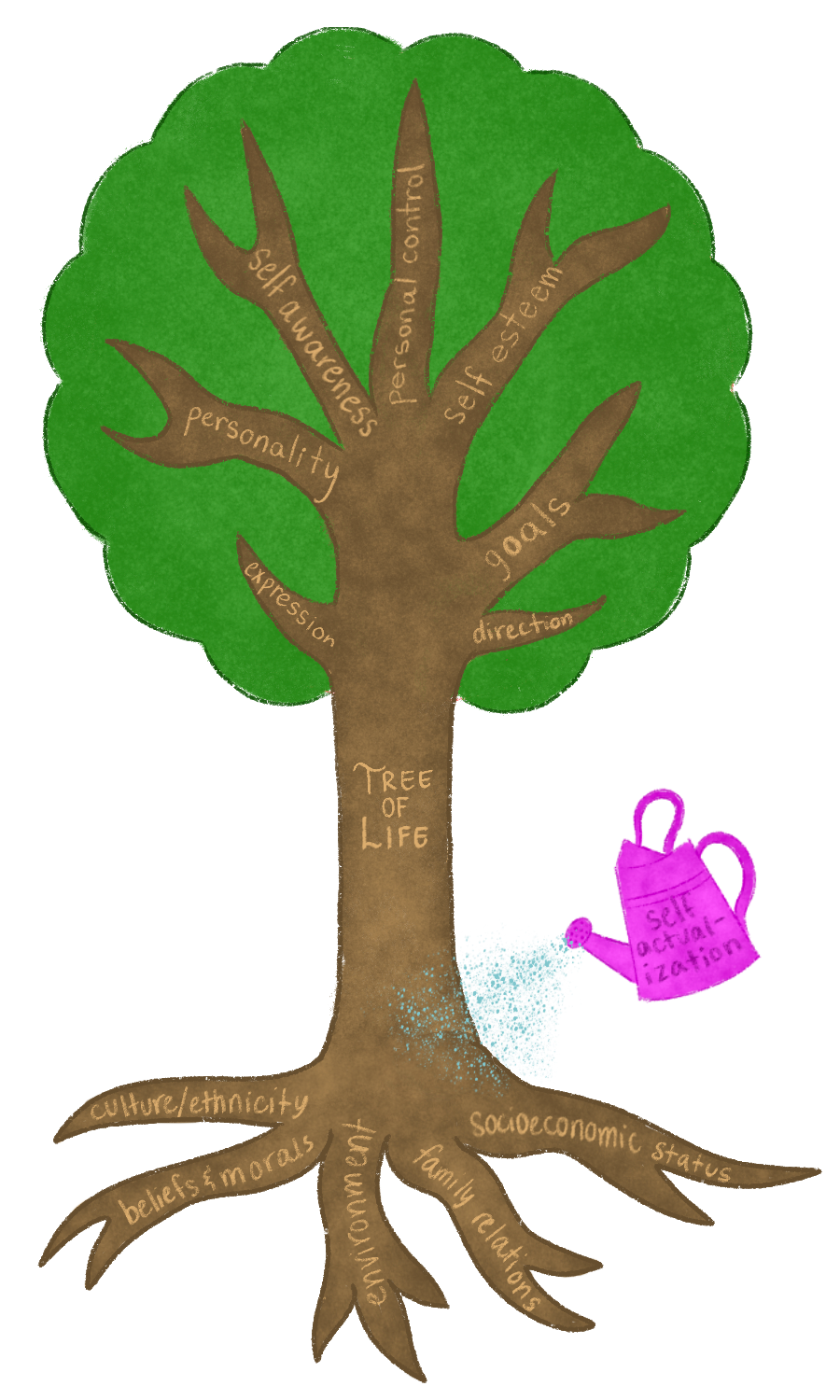
Environments fluctuate based on various conditions: socioeconomic status, education, physical conditions and much more. Achieving self-actualization can be more difficult in certain environments depending on the neuroplasticity built up in the brain.
Although achieving self-actualization is usually considered a lifelong process, allowing the brain to openly develop with positive reinforcements is important to paving the way for the best life possible, especially for teens and young adults.
Illustration by Amelia Martorano/Bear Witness



Leave a Reply